Thursday, March 30, 2017

THE MORAL OF THE STORY: GRASSROOTS PRESSURE ESSENTIAL TO XCEL’S ENVRIONMENTAL CREDENTIALS


Minneapolis Energy Options tapped into the legitimate and well-founded desire for more clean and renewable energy to effectively launch a campaign challenging Xcel. However critics of the campaign pointed out the irony of how Xcel was already the #1 wind energy leader among utilities in the nation. 
Minneapolis Energy Options was hence vulnerable to an interesting political ju-jit-su where the strength of the campaigns environmental goals would be turned into a weak argument against a utility that is already relatively green. Does this mean that launching the campaign to further challenge Xcel and call their Minneapolis service territory into question was a foolish or unproductive move? Should we have instead backed away, shown appreciation and rewarded Xcel for having so much more wind power generation than most utilities? The campaign was fully worthwhile because Xcel needs to be pressured by the grassroots to make pro-environment progress.
Xcel has a history of doing clean energy and energy efficiency investments only after intense community pressure.
Xcel CEO Ben Fowke acknowledges this at the CEE Energy Policy Forum on January 27th, 2015.
“Before we talk about the future I want to talk a little bit about our accomplishments and we did this together. Now sometimes we needed a little push and some in this room might say we needed a little shove. Sometimes we had to shove back a little bit. But you know what? At the end of the day we have accomplished a lot already, not the least of which is #1 wind energy provider in the United States and have been for a decade now.”
NOTE 1

  Much of the environmental credentials that Xcel takes credit for in their masterful public relations messages actually originate primarily as a result of the success of people-powered grassroots efforts like Minneapolis Energy Options and the policy makers won over by these grassroots movements.  Different examples as they come in the news could be tied into this narrative
For example, Xcel only converted the Minneapolis Riverside plant from coal to gas only after an intense clean energy grassroots community campaign which they opposed. Nevertheless Xcel now touts converting the Riverside coal plant to natural gas as one of their major green credentials.
http://www.minnpost.com/sites/default/files/images/thumbnails/articles/XcelEnergyRiversidePowerPlantThumbB.jpg

Xcel only agreed to do so after a major coalition of environmental organizations (Clean Water Action, the Izaak Walton League, the Sierra Club, Environmental Justice Advocates of Minnesota) neighborhood groups, and local policymakers put together the Clean Energy Now campaign. Xcel’s original plan for the Riverside Coal Plant was to try to somehow meet legislative requirements to reduce air pollution while continuing to burn coal.  
NOTE 2

I have a personal story to tell to illustrate this narrative. Working for the Minneapolis Energy Options campaign was a bit of deja vu to my life. I have prior experience in Colorado working for a successful ballot initiative that Xcel was also campaigning against at the time. Clean energy advocates took advantage of Colorado’s citizen’s petition process after repeated attempts to get a renewable energy portfolio standard though the Colorado State Legislature had failed. I was personally part of the effort in mid-2004 to gather enough signatures to put the renewable standard onto the ballot as Amendment 37. Then on Election Day 2004, Colorado became the first state in the nation to pass a renewable energy standard by a statewide vote. It required Colorado’s top utility companies to sell 10% renewable energy by 2015.
I remember attending a jobs fair at the University of Denver and asking the representative at the table for Xcel Energy about Amendment 37. He did confirm that Xcel officially opposes amendment 37 and said it was because the intermittency of wind energy supposedly makes it an inadequately reliable source of energy. Let’s fast forward ten years later to July 15th 2014. Xcel in Minneapolis hosted a public event outside their downtown headquarters in celebration of 10 years as the nation’s top wind power utility. How did this happen?
Ten years earlier, when Xcel was faced with the possibility that voters could force them to use a greater share of renewable energy, Xcel Energy chose to mount a full-scale resistance campaign in the weeks prior to Election Day 2004 spending about a million dollars to run ads against 37. However once Xcel was faced with the public authority of voters approving the measure, Xcel pooled their technical expertise together found a way to make wind power work. They ended up meeting the renewable standard 8 years ahead of schedule and even approved of then-Governor Bill Ritter increasing the renewable requirement to 30% by 2020. Xcel began subsidizing solar installations in 2006 in order to meet the requirements of Amendment 37. The metro Denver area saw direct employment in the renewable energy sector in more than double to 13,940 in 2007 from only 5,760 in 2004 while the number of renewable energy companies increased 9 fold in the same time period. NOTE 3
So Xcel then took credit for this progress that was accomplished due to the political success of a policy they has initially opposed.
It was 20 years before the celebration in their downtown plaza that Xcel in Minnesota got ahead in the wind energy curve among the utility industry, though they did so for rather controversial reasons. In 1994, Northern States Power (now a subsidiary of Xcel) agreed to a wind-power mandate in exchange for getting what they wanted with the Prairie Island nuclear waste storage site. In doing so, they enraged many of their counterparts in the investor owned utility business for setting a precedent of making renewable energy deals that the industry was more universally hostile toward at that time.

Overall, Xcel is not at fault to celebrate and take a lot of credit for their recent investments in new wind energy capacity. It is just essential to point out that their more investments in wind energy capacity are merely what is required to meet the state’s renewable energy standard that the legislature passed with overwhelming bi-partisan support back in 2007. The standard requires Xcel to get 30 percent of its electricity from renewable sources by 2020.
Xcel loves to point out the Solar Electric Power Association ranking them among the top 10 utilities in America for solar capacity. NOTE 4
But does Xcel ever make it clear in their PR messages which state governments made Xcel meet solar goals through legislation?
In 2013 Xcel did formally oppose the Minnesota senate solar mandate bill requiring investor-owned utilities to use solar power for 1 percent of their customers’ needs by the end of 2025 on behalf that it would cost $250 million; NOTE 5 which is a figure far less than the cost overruns of their Monticello facility upgrades. 
  Similarly Xcel had to be forced by the legislature to allow shared community solar arrangements- an idea that is very popular with the public.
Yet once Minnesota’s solar gardens law was in place, Xcel spokespeople were vocally amenable to allowing community solar projects so customers whose homes are not suitable for their own solar install could invest in part of a solar array elsewhere. “It is kind of unfair to put together a big solar incentive program and then not allow them to participate because they just happen to live in a shady spot,” said Rick Evans, Xcel’s director of regional government affairs. “We do a solar gardens program in Colorado. It works very well. It is very popular. We want to do one here.”  NOTE5

The big takeaway lesson and the big moral of the story is that we can’t let entities like Xcel win a political victory on their initial resistance to change. The company has shown great ability to meet clean energy goals once they are set, but at times still to be challenged by the public or else it will be all status quo and lost opportunities for substantial progress.


The pressure from grassroots energy campaigns shows how we can challenge the incumbent corporate- owned utilities to improve their business practices, financing models, and investment strategies. Giving no challenge and simply bowing in subservience to their incumbency would not trigger innovation and would stagnate product development of new energy services. Placating their initial gravitation to maintain the status quo runs counter to mission statements of bringing out innovation.

Monday, March 27, 2017

WHAT HAPPENED TO MINNEAPOLIS ENERGY OPTIONS AFTER BALLOT INITIATIVE DID NOT MATERIALIZE?


WHAT DID THE CAMPAIGN DO AFTER THE PUBLIC HEARING?

Following the public hearing, there was an impression among many supporters that Minneapolis Energy Options had lost and that all we had worked for only resulted in a framework resolution.

Now out of the media spotlight and relieved from the task of campaigning for a ballot initiative, there was a lot of internal soul searching within the campaign. It took until October for the campaign to come back together on behalf of a long-term strategy. We put matters in perspective that this was a long game and there would be some setbacks along the way.

For comparison, Boulder Colorado was also in a long game. Boulder negotiated with Xcel for 5 years to collaborate on clean energy goals and get a smartgrid without making much headway before choosing to pursue to take the municipalization option.
In October 2013, Minneapolis Energy Options did an internal poll chose a new name for itself to fit in with the long-game strategy. The new name chosen was "Community Power" which would become an umbrella organization to house the work Minneapolis Energy Options had started. We would continue to use the project name "Minneapolis Energy Options" for our local efforts in Minneapolis. Because the name Minneapolis Energy Options implies being a Minneapolis only campaign, we needed the broader organizational identity of Community Power to enable us to start working with and supporting communities across the state undertaking similar efforts.
THE POWERFUL CONVERSATIONS TOUR
On November 21st, 2013 and on December 1st, 2013 Community Power held the first two deep community education events in what is called the Powerful Conversations Tour. The idea for the Powerful Conversations Tour originated as a way to do campaign fundraisers at house parties.

But following the demise of the ballot initiative campaign, the idea of the Powerful Conversations Tour still had a key purpose. It was adapted to address an overall pattern Minneapolis Energy Options and MPIRG noticed while talking with thousands of people about supporting the ballot initiative.
 A great number of Minneapolis residents expressed excitement upon hearing that we have an opportunity to participate in shaping our energy future. However most people we talked to felt like they did not know enough about our energy utility system to make an informed decision on what actions to take. They felt they needed to better understand how our energy system works in order to articulate a vision on exactly they could do to address energy concerns.
We thus realized a need for greater community education on the basics of how our energy utility system works. The more people who lack understanding of how our energy utility system works, the more people who could be easily persuaded by the well-moneyed PR campaigns from Xcel and the utility powers that be. That lack of widespread public knowledge would have been a big stumbling block for the ballot initiative campaign if it had materialized.
Regardless of whether a ballot initiative is happening or not, knowledge is power as we shape our energy future. And so the Powerful Conversations Tour gave me something to organize for in the absence of an all hands-on-deck campaign.
Recruiting hosts and attendees to the series of energy education events replaced phone banking at MPIRG and canvassing with a clipboard as the main campaign tactic for Minneapolis Energy Options. Through the Powerful Conversations Tour series of energy education events, we commenced the work of building a base of informed community leaders we would need to grow the campaign in the months and years to come.

By the end of 2014, we had done close to 40 Powerful Conversations Events with hundreds of attendees. 

POST-PUBLIC HEARING WINS- CITY COUNCIL APPROVES PLAN B FOR MINNEAPOLIS ENERGY OPTIONS


WAS MINNEAPOLIS ENERGY OPTIONS STRATEGICALLY SUCCESSFUL IN ACCOMPLISHING INTENDED GOALS?

      There are indeed critics of the Minneapolis Energy Options campaign who said simply laying out thoughtful proposals directly would be more virtuous and less distracting than instigating political theatre on going for municipal utility.

An example was an August 10, 2013 Star Tribune opinion piece co-written by Tom Horner and Tim Penny:
“In their defense, advocates of the Xcel takeover are right in calling for the design of a new energy future. Minnesota has the incentive — its wealth of natural resources and environmental assets — and the capacity — its technology talent — to be a leader in this arena. But threatening Xcel with a hostile takeover is an unnecessary distraction. It is the strategic cousin to the Republican tactic of forcing Congress to take vote after vote on repealing Obamacare (something that will never happen while Obama holds a veto pen). Political theater at the expense of thoughtful policy is no more attractive from the political left than it is from the right. Too often, this political grandstanding focuses attention on peripheral issues or unrealistic promises.”

NOTE 1


By the time the editorial was printed, the drive for considering a municipal utility was at dead end so the end effect of the editorial was a critique of the strategy: The strategy of trying to put this issue to a vote in 2013 in order to give a shock to Xcel/ Centerpoint before rather than during the franchise agreement negotiations. Having the campaign in a municipal election year was also strategically timed to set up political theatre as it gave the various candidates for Mayor and City Council the opportunity to exalt their green credentials and make energy into a campaign issue.
Now the question is, could the advocates “calling for the design of a new energy future” have gotten Xcel to share the same incentive without threatening Xcel with what they perceive of as a “hostile takeover”?
Basically low-risk means low-reward. This story brings about yet another lesson on the essential importance of exerting community pressure in advocating for a better outcome as opposed to merely placating the status quo. There is something about this particular political theatre and controversy that finally managed to generate widespread public attention on the topic of energy in a way that small piecemeal policy proposals and isolated neighborhood projects could not.
I was doing outreach for far less controversial proposals in my experience with the Our Power Project; ones about individuals saving energy in their own homes. We attempted to get residents we spoke with to be block club leaders and engage their neighbors in energy saving programs and action steps. However this non-controversial idea did not generate enough excitement or enthusiasm to build committed volunteers like Minneapolis Energy Options did.  
Winning the ballot initiative was not the endgame for Minneapolis Energy Options. The campaign won just by making this an issue. It is fantastic we are finally talking about energy in Minneapolis rather than glossing the issue over. So now that the issue of energy has gotten city-wide attention, we can tell a larger story and more people will be excited to show up at energy related events. The work we have done has inspired people for the further work we can accomplish in the future.
We want to have widespread public attention, enthusiasm and interest on the topic of energy in order to unlock our “environmental assets, capacity and technological talent” that Horner and Penny were referring to.
The question is if the Minneapolis Energy Options campaign (along with Xcel) was generating the right kind of attention or the wrong kind of attention.
   If it is true that Xcel was previously undetermined to negotiate with the city insiders on reaching Minneapolis’ climate and energy goals, then we generated the right kind of attention. There is no indication that the drive to put the initiative on the ballot in 2013 was a move that backfired or burned bridges. Far from burning bridges, the initial momentum in calling for a ballot initiative has already pushed Xcel to create a better dialogue with environmental groups.
Horner and Penny might not have foreseen it at the time but there was victory in the larger goal of pressuring Xcel Energy to come to the bargaining table. Since the initial goal of support this referendum was to bring Xcel/ Centerpoint to the bargaining table, then the “grandstanding” strategy was a success.
Minneapolis Energy Options deserves credit for putting this resolution on the table but City Council deserves credit for taking the risk of holding the public hearing.
The fact that the City brought up the mere possibility of transferring our electric utility to public ownership caused Xcel to give deeper thought about its negotiating stand.

NOTE 1 Minneapolis utilities debate is a distraction

·        Article by: TOM HORNER and TIM PENNY 


THE PUBLIC LETTER EXCHANGE BETWEEN XCEL AND MAYOR RYBAK

On 8/5/2013, the Monday after the public hearing, the core group of Minneapolis Energy Options met with a core group of Xcel Energy officials.
At the meeting, we showed the Xcel Officials the list of 24 recommendations from CEAC (Minneapolis’ Community Environmental Advisory Committee) wanted out of the franchise negotiations. SEE APPENDIX We sent a message to this core group of Xcel officials that Minneapolis Energy Options was here for a serious agreement. We explained to Xcel officials that we want each and every of the CEAC recommendations – all 24 of them rather than for Xcel to dance around and cherry pick the lowest-hanging fruit.

This meeting resulted in Xcel/ NSP executive Dave Sparby sending public letter to Mayor Rybak on August 8th, a letter making a commitment to be a good partner with Minneapolis’ Energy goals in exchange for keeping the referendum off the ballot. The letter contained the statement
 “We see much common ground and believe we can effectively collaborate with the city building on our long history of working together.” NOTE 1


The specific commitments in Xcel Energy put forth in the letter sounded good to the average reader. But to those who follow energy policy news more closely, Xcel chose to publicly commit the 5 things they were already required to do by law out of the whole list of 24 items. The five different “clean energy concessions” Xcel made to the city in this letter was Xcel basically promising to follow through on community solar and standard renewable energy contracts that were already required for them to do under state law and repackage them as their own ideas.  The items from the CEAC list that were omitted from the letter tended to be the items not required of Xcel by state law.
Although Xcel may have been picking the low hanging fruit according to what was already state law in choosing specific content of the letter, the overall picture the letter painted was a significant step forward. At last, Xcel made promises the City could hold them accountable to.

Later the same day, Mayor Rybak sent President Sparby a detailed response in which he expressed “real hope that we can seize opportunities that have been missed in the past” — including, renewable powered the City’s streetlights, making a solar investment at Xcel’s Riverside plant, and to provide Minneapolis-specific reliability reports. NOTE 2 Mayor Rybak added, “I also thank advocates, including Minneapolis Energy Options, for pushing our community and me to expect more and for insisting on a more sustainable energy system for future generations.” NOTE 3
This exchange of public letters took away any remaining public expectation that City Council would even take a vote on the original resolution.


THE FRAMEWORK RESOLUTION CITY COUNCIL PASSED ON AUGUST 16th

In addition to the meeting with Xcel, Minneapolis Energy Options also negotiated with City Council on a plan B following the August 1st hearing. City leadership concluded that the ballot initiative was not in a place to win that year, and losing a ballot initiative would undermine City Council’s power in the 2014 franchise negotiations. So instead of preparing to take a vote on whether to put the initiative on the ballot, City Council started working to develop a framework for the upcoming utility franchise negotiation process for 2014.
 about how city would negotiate and check in on negotiations based on energy pathways study that would be finished in 2014.

August 16th had originally been looked forward to as the make or break moment of truth where we would finally figure out which on-the-fence council members were for or against Minneapolis Energy Options making it onto the ballot. But then the focus for August 16th became to pass a plan B so that Minneapolis Energy Option would not leave empty handed in the quest to hold the utilities accountable to their promises.
https://scontent-ord.xx.fbcdn.net/hphotos-xpa1/v/t1.0-9/1150336_619926681373962_127247721_n.png?oh=80e486cd9a38f2b3907c8aaa0cdb479b&oe=5555DD9B

On August 16th of 2013, the city Council unanimously adopted “Framework for Reaching City of Minneapolis Energy Goals” (RESOLUTION 2013R-353), that paved the way for the city to hold the utility accountable to the city’s energy goals. The resolution articulated the steps ahead for the 2014 franchise negotiations with Xcel Energy and CenterPoint Energy. It and reaffirmed the City Council’s commitment to using the franchise negotiations to leverage affordable energy for cost-burdened families, reliable energy for city businesses, and local clean energy for the city’s economy and to continue
The resolution required the City Council to adopt an energy vision and goals for the franchise agreement negotiations, including those goals already laid out in the Minneapolis Climate Action Plan.
The resolution ensured these goals and information drawn from the Energy Pathways Study would be expressed in the negotiations with Xcel and CenterPoint.
The resolution also set a timetable for city staff to begin negotiations with the utilities and report the progress to City Council by mid-2014.
The resolution also affirmed Minneapolis pursuing energy reforms at the state level that will give the City more flexibility to implement its energy goals.
The first results of the framework came on September 9th 2013 when the Minneapolis City Council adopted the energy Vision Statement that closely echoed the message of Minneapolis Energy Options. It reads, “In 2040, Minneapolis’s energy system will provide reliable, affordable, local and clean energy services for Minneapolis homes, businesses, and institutions; sustaining the city’s economy and environment and contributing to a more socially just community.” 
This energy vision was created to provide the Energy Pathways Study with formal guidance.


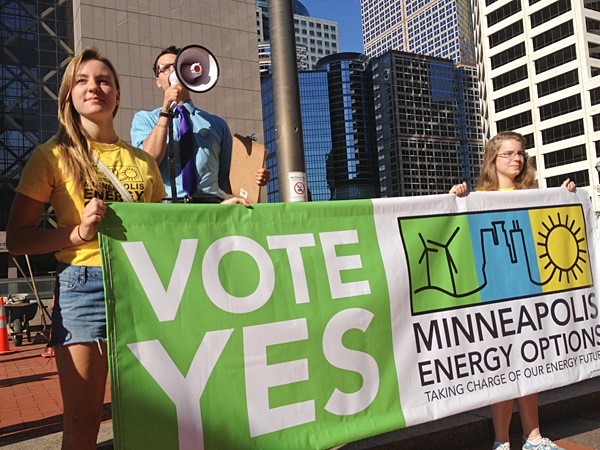
THE MINNEAPOLIS ENERGY OPTIONS CAMPAIGN'S BIG DAY: THE AUGUST 1ST, 2013 PUBLIC HEARING


THE AUGUST 1ST, 2013 PUBLIC HEARING


While the August 1st 2013 public hearing did not go as the Minneapolis Energy Options campaign had initially hoped or envisioned, it did bring a silver lining in that both utilities agreed to be collaborative and cooperative partners with Minneapolis' ambitious climate and energy goals.

The public hearing which took place in City Hall was spacially arranged in a way where there was a whole section of the City Council Chambers and overflow room that appeared to be reserved for officials with Xcel, Center Point and their numerous employees they brought to attend the hearing. In contrast, there was no such special area reserved section for supporters of the proposed referendum. Before the public hearing began, the top executive spokespeople from Xcel and Center Point were given 10 minutes each to present their case how the referendum was unnecessary at best, how everything was generally fine with their operations and that there is nothing worthy of the city worrying about. However, no one in favor of the proposed referendum was given an equivalent 10-minute time window to set the tone for the public hearing. Allegedly the Minneapolis Energy Options campaign (or anyone willing to speak on behalf of the campaign) was not qualified as a legitimate stakeholder. During these 10 minute periods both utilities promised to be good collaborative partners in meeting Minneapolis’ energy goals with the very apparent intention of rendering the ballot initiative as unnecessary as a way to convince City Council to keep it off the city-wide ballot. But these promises they made set the stage for a long-term win as far as the goals of Minneapolis Energy Options. 
After Xcel and Centerpoint got the privilege for setting the tone for the public hearing with the 10 minutes each, the rest of the 60 plus public speakers on either side were given 3 minutes each.


First of all we had the usual dilemma where coalition supporters who were informed about the issue who wanted to speak but could not fit Thursday morning into their daily work schedule. Meanwhile, Xcel gave all their employees the option to take a paid day off to come and speak even if they were not fully informed about the issue and mainly wanted to express being a team player. 


 The Minneapolis City Council witnessed quite a wide segment of constituents come together to speak in opposition to putting proposed referendum on the ballot, (though not for reasons refuting clean energy). Certain Trade Unions, some individuals who said they “barely got by,” and the head of a nonprofit agency that serves the poor all came together in alignment with the Chambers of Commerce and big business types to take sides with a fortune 500 utility company.
Even before the public hearing took place the Minneapolis Energy Options campaign felt burned by unity of various Chambers of Commerce, the Downtown Council, and some trade union leaders / members all siding with Xcel’s position that the resolution was too dangerous to even consider. It was only a very tenuous short term alliance that went away after the public hearing and did not come to haunt the further work of Minneapolis Energy Options.

One side of the opposition included the big money financial types were not excited about the initiative because municipal utilities don't generate dramatic windfall profits for bond market speculators.

The certain trade unions that fell into the opposition internalized the predictable corporate fear- mongering that transitioning to a municipal utility would spell the end of their union jobs as the know them or a significant disruption. Both the corporate types and their and the unions who grew subservient to them in this case convinced each other that there would have been some irreconcilable difficulty for the city to re-employ those same workers that NSP/Xcel uses now but under city management. Then again, perhaps some unions leaders opposed the resolution not because of any real danger Minneapolis Energy Options supposedly posed for their jobs/ benefits but perhaps because they did not want to make Xcel angry at them.

 The same trade union leaders and members who expressed such great worry about the city spending hundreds of millions of dollars in bonds to buy back the electric grid (that passing the ballot initiative would not even require) were the same unions who cheering for the city and/ or the state to spend hundreds of millions of dollars for a new Vikings stadium without taking a ballot initiative to the people. By all means, not all unions were in the opposition. Javier Morillo, president of Service Employees International Union Local 26, spoke at the outside rally in favor of Minneapolis Energy Options though not inside City Hall at the public hearing. But it was by no fault of his own because there was one key reason why getting as many speakers in favor of the resolution to show up as there were against the resolution was an uphill battle.

While the opponents of the Minneapolis Energy Options resolution showed quite a broad coalition, not enough environmental groups and coalition partners of Minneapolis Energy Options showed up to speak at the public hearing, largely because we mistakenly did not ask them to.


What caught the campaign off guard was that someone from City Hall had recommended/ directed the Minneapolis Energy Options campaign to have about 10-15 well-polished and on-message speakers for the public hearing. 

Rather than trying to turn out the maximum number of supportive speakers for the public hearing in City Hall, the bulk of the phone bankers for Minneapolis Energy Options (such as myself) were given a different task. We prioritized driving maximum attendance to a rally held outside City Hall in the hour before the public hearing began. As a result the attendance to the rally was quite decent; about 150 showed up on a summer weekday morning.


But in hindsight, the rally unexpectedly posed a logistical trap for the campaign. Because some of the anticipated speakers for the rally showed up as little as 15 minutes late, the pro- Minneapolis Energy Options crowd got behind schedule and did not come upstairs to the City Council Chambers until 9:45 AM rather than the originally planned 9:30 AM. Because of these lost 15 minutes, a huge number of the opposition speakers got a chance to sign up on the roster to speak before the attendees at the rally outside made it to the sign in table.


The media was all set to cover the public hearing as it started with their cameras in hand. However, because such a great proportion of the early public speakers were in opposition to the resolution, the media that typically feeds off of controversy of differing opinions quickly lost interest and ran away with the headline that opposition was overwhelming.
There were indeed many supporters of the referendum present but they had to wait quite a while for their turn to speak.


The core message of those speaking in favor of the Minneapolis Energy Options Resolution was to bring up reasons why the status quo is unacceptable in order to undercut any suggestions of “if it ain’t broke don’t fix it.”
The longtime energy activist George Crocker so eloquently put it in the public hearing:
     “Business as usual will not give you good jobs, will not give you a clean environment, will not allow this city to grow and prosper. Business as usual will put us on the scrapheap of history where it is littered with civilizations that eroded the ecological foundations they depended on for their survival, and then they perished. That is the track we’re on. Deny it.”  NOTE 1

Despite sometime quoting such passionate commentary, the mainstream press ran with the headline that there was overwhelming opposition to the referendum at the hearing in their reporting.
In addition, the mainstream press reinforced the “municipal v. Xcel” and “takeover” narratives that were quite different from the frames Minneapolis Energy Options used in the run up to the DFL endorsement. 

If we had foresaw the process better we would have recruited more speakers ahead of time and would have directed them to be up at the third floor early to sign up to speak rather than wait for all speakers at the rally. In hindsight we needed not need just a few, talented speakers. Having a great quantity of speakers is what mattered in creating an overall impression of how much support there is among constituents.
Then again, in the case of Minneapolis Energy Options, not even playing a good numbers game may have mattered at that point. It is more than likely that even before the public hearing took place the majority of the city council were already secretly planning on killing the resolution and looking for some way out of it, primarily because Xcel’s letter to ratepayers triggered angry messages from constituents.

NOTE 1 ( CITATION FROM http://www.minnpost.com/two cities/2013/08/minneapolis-utility-takeover-unions-and-businesses-join-forces-against-energy-act Minneapolis utility takeover: Unions and businesses join forces against energy activists Share on printShare on email

By Karen Boros | 08/02/13 )


THE OPPOSITION TO THE RESOLUTION HAD PREDICTABLE AND UNPREDICTABLE RECURRING MESSAGE THEMES

Here are the recurring message themes that at a communications team meeting Minneapolis Energy Options held on Friday, July 12th . We accurately predicted what five of the opposition messages were going to be that opponents against the resolution used up to and during the public hearing. There were a couple additional opposition message themes that turned into unexpected moves moves of political ju-jit-su.

Opposition Message #1- We are not ready yet!: “It is too soon to bring this up to a vote before the Energy Pathways Study is done.”

Opposition Message #2 -Contentment with the status quo: “Xcel is good enough. It is a national wind energy leader, it brought in 1000 trucks after the June 21st storm and and we don’t see power outrages less than 99% of the time” 

Opposition Message #3 - The cost of the municipalization process: “It will cost billions and billions of dollars more than we can bond for and it will freeze the cities assets and explode our debt and put our bond rating in jeopardy.”


Opposition Message #4 - Fear of the unknown/ unfamiliar: “There is too much we don’t know” “Business will not want it and might leave the city” “We have not done this before so it is scary” “service might be unreliable”

#5 Lack of trust that City Government has integrity or competence: “The city council will corrupt this with conflicts of interests” “The city can’t possibly pull this off with so many other things it has not taken care of” “Politicians are not equipped to handle running s utility” “The city does not have same level of expertise as the utility in place” “A municipal utility will still have the same monopoly problem just under the new management of bureaucrats rather than business”

No matter how many pro-municipal power talking points the campaign could have used, they all lack relevancy in the face of people who are convinced that the city can’t even fill potholes, remove dead branches, fix water maims or plow snow at a satisfactory rate. That is the reason that prevented skeptics of the municipal utility authorization ballot initiative from being convinced by arguments that municipal power would provide better rates or superior quality of service. If they see the Minneapolis city employees as having too many basic tasks then getting into the electric business would thereby be presented as too much to handle.

A 6th opposition theme was a message of solar energy pulling political ju-jit-su on Minneapolis Energy Options. Jerry Wendt spoke at the public hearing against the Minneapolis Energy Options resolution because his condominium association was scheduled to spend $330,000 to install solar panels on its roof in the fall. In his words “The only way we can do this is with Xcel rebates. We don’t want this to blow up in our faces.” NOTE 1
The solar rebates that Xcel offered willingly or unwillingly hence created an unexpected buffer between considering a municipal utility and an agenda to install more solar panels.

When the Minneapolis Energy Options campaign began in late 2012/ early 2013, making community solar arrangements available was one of the biggest motivators for pursuing Municipal Power.
However something changed that dynamic in the time period after the Minneapolis Energy Options campaign began but before it heated up in June and July. The Minnesota State Legislature passed a law requiring that investor-owned utilities like Xcel offer community solar rebates to their customers while exempting municipal utilities and co-ops from the requirement. This fortunate news from the state legislature turned one of the strongest arguments for switching to municipal power into a pro-solar power argument in favor of the status quo as municipal utilities were exempted from the solar gardens law.

#7 The seventh opposition theme was not a message per se, but was still political ju-jit-su. It was a big message of public silence from the more technocratic grasstops organizations who are most active and knowledgeable in the energy policy field. Because of Xcel’s monopoly influence, so many of the successful energy policy organizations shied away from being public supporters of Minneapolis Energy Options even if the individuals who worked for them were privately or individually in favor.
Xcel bankrolls some very well-meaning energy saving programs plus some solar rebates thus making it awkward for people working for these programs to join in with any movement to displace Xcel from Minneapolis. Professionals who make their living under the Xcel money tree might offer some fine state policies or some visionary ways to improve the energy behavior of individuals but could not be vocal proponents for providing a competitor to Xcel’s overall system of energy management.

Why should the city even need to pursue different energy options when we already have an abundance of feel-good, energy-wonk programs? The reason is there has only been marginal progress in actually cutting down electricity and gas sales compared to what could be or should be happening.  Perhaps the unchecked influence of utilities whose profits are dependent upon sales prevented the programs being too effective.
 However the success of Minneapolis Energy Options provided the space for the organizations like CEE to become much more visionary with exploring systemic change for energy options. CEE became the organization that did the Minneapolis Energy Pathways study. 

NOTE 1 ( CITATION  FROM http://www.minnpost.com/two cities/2013/08/minneapolis-utility-takeover-unions-and-businesses-join-forces-against-energy-act Minneapolis utility takeover: Unions and businesses join forces against energy activists Share on printShare on email

By Karen Boros | 08/02/13  )

POSSIBLE NEGATIVE OUTCOMES IF A MUNICIPAL UTILITY HAD BEEN PURSUED
In summary, the brief but stomping campaign against the Minneapolis Energy Options resolution did not make their arguments on the turf that Minneapolis Energy Options was comfortable or familiar with. They did not argue against whether or not a municipal utility is superior in theory, which the campaign had refined arguments for. Instead they argued on their turf that the practical process of switching to a municipal utility would be too daunting, costly and time-consuming (despite the resolution not requiring an acquisition of Xcel’s infrastructure.
There was no denial that there are many successful municipal utilities. But there is also no denial that most successful municipal utilities were cities that were municipal utilities to begin with or had been for decades. What the arguments focused on is that it is unusual for a city the size of Minneapolis to make the transition from a corporate power company to a municipal utility.
 It would be great if the City of the campaign can wave a magic wand and suddenly create a municipal utility. However, because the resistance of the incumbent utilities will be so fierce, it means following through with the actual process of municipalization will take many, many years before the envisioned municipal power utopia sets in. It would likely be a prolonged struggle because Xcel will not simply give away all their power lines, transformers and substations within the city limits out of the goodness of their hearts. There is a very real fear that the process will be tied up in expensive litigation for several years before any real progress on clean energy and emissions reductions even begin to happen.
That would be a worst case outcome of passing the Minneapolis Energy Options resolution.
In that scenario, environmental activists would probably grow impatient and start wondering how exactly the municipal ownership of wires, meters, & transformers would move momentum toward reducing greenhouse gas emissions.
The city's overall goal of increasing the use of green energy would get mired in complexity over who owns the poles, the wires and the meters even though that was considered a necessary step to allow the city to construct renewable-resource power generation within the city.
Even if Minneapolis could simply condemn and acquire the infrastructure from Xcel on short order, we would still be at the mercy of power plants outside the city unless local renewable energy is already in place. A Minneapolis municipal utility we will have to buy all our power on the open market from the companies producing which introduces uncertainty. But the benefit is that Minneapolis would no longer be on the hook for paying off Xcel’s stranded costs.
If consideration for municipal power is brought up again in the future, let this be a guide of discussion issues to watch out for.

THE SPIRIT MOVED ME TO SPEAK AT THE PUBLIC HEARING
Looking back, why critique Minneapolis Energy Options for considering a municipal utility?  If state statutes would have given us a less drastic way to create a competing energy management without the seeking authorization to municipalize, then the campaign would have already done so.
The Minneapolis Energy Options party line was that the option to municipalize provided the city with its biggest legally available option to leverage Xcel into making concessions on all 24 items that CEAC (the Minneapolis Community Energy Advisory Committee) wanted out of the utility franchise negotiations.
I had not initially planned on speaking at the public hearing. But during the public hearing, I did not like where the discussion was going so I felt an urgency to pivot the conversation by speaking to the City Council. The public hearing that had numerous speakers attacking the idea of municipalization rather than the campaign itself. Midway through the hearing, I could see the writing was on the wall as far as Minneapolis Energy Options not making it onto the ballot.
Because the public hearing was more narrowly focused specifically on whether to put the referendum on the ballot, I was in a tricky place to come up with a message. As soon as everyone knew that municipalization on short order was politically unlikely after all, it put the campaign mission of Minneapolis Energy Options into an awkward position.
The message became something along the lines of “I say I am in favor of this ballot initiative because I want the city to have at least some leverage to use for the upcoming franchise agreement negotiations in 2014 but I do not really want to push for a city operated utility because too many people are attacking the idea of municipalization for it to pass as a ballot initiative.”
 I introduced myself to the council as someone who was doing outreach for Minneapolis Energy Options upon the understanding that the only action a yes vote on the referendum would require is a feasibility study. I complained how the referendum was being willfully misrepresented as a jump straight to municipalization by people who conveniently glossed over any mention of a feasibility study being required.
I reframed the campaign in its most positive light: as a broader movement which brought momentum in finally getting a city-wide discussion about clean, affordable, reliable and local energy. I wanted to present the campaign as a catalyst to deepen and diversify grassroots action around energy solutions, climate mitigation and environmental issues with the benefit of bringing multiple organizations to converge around taking charge of our energy future.
 The real issue I wanted to keep public discussion focused on was about maximizing the opportunities for local renewable energy generation in order to build community resiliency and stopping abuses of legalized monopoly power which limit that potential rather than the technicalities of who owns the electric grid.
The takeaway message I made clear to the City Council was that I did not want these valuable city-wide public conversations about our energy future to be drowned out by the fearmongering, costs and uncertainty around municipalization. I expressed that preparing for peak oil and mitigating a compounding climate crisis was the truly important contest before us and I asked for reassurance that elected officials and utilities would give voice to these serious concerns.

I also spoke at the public hearing because I wanted to defend the dignity of the campaign from this multitude of arguments against municipalization. My takeaway message on that was to state that an actual move to municipalize was never our intention in the first place and our motive was instead to provide the city leverage for its utility franchise negotiation. However this was a slippery slope argument for the campaign to make in a slightly different scenario. If the campaign revealed municipalization was never a credible option after all, how could it possibly be used as leverage for negotiation?
Decoupling Minneapolis Energy Options from municipalization may have been a way to defend the legacy of the campaign from those who were fearmongering on the costs and uncertainty. But I later became quite worried about an equal and opposite reaction where our gung-ho pro-municipal utility campaign supporters would see our previous talk of municipalization as insincere posturing and might not trust Minneapolis Energy Options again.
Likewise, the city council probably had similar worries that constituents would misinterpret the whole episode a manipulative ploy to get more franchise fees out of Xcel in the next franchise agreement.
At the time I had worry that the leverage we had worked for in the campaign would be lost. However, the leverage Minneapolis Energy Options was working to create showed up in a slightly different form than expected. The utilities were surprised that the City Council made it as far as holding a public hearing. That alone ended up being was enough to convince Centerpoint and Xcel that negotiating a deal with the city was the better way to go than not taking offers to negotiate seriously.

http://images.publicradio.org/content/2013/08/01/20130801_municipal-utility-supporters_33.jpg

https://scontent-b-ord.xx.fbcdn.net/hphotos-xpa1/v/t1.0-9/1208969_636568916376405_1793504867_n.jpg?oh=b729f3eacbc04f8b810bdde28a63f531&oe=552607E3